

Last updated: November 19, 2026
CO2 laser under the eyes can improve crepey skin and fine lines in appropriately selected adults, but it cannot remove protruding under-eye fat. Whether laser treatment makes sense depends on what is causing the change you see – skin texture, pigment, hollowing or eyelid tissue. At NW Laser in Vancouver, Washington, we offer Fraxel laser treatment for delicate eye-area wrinkles.
What Can CO2 Laser Under Eyes Treat?
CO2 laser resurfacing under the eyes can soften fine lines and crepey texture by renewing the skin surface and stimulating collagen. The best target is a change in skin quality, not a bulge beneath the skin. A careful assessment distinguishes wrinkles from protruding fat, hollowness, pigment and more substantial eyelid laxity.
An article on the American Academy of Ophthalmology’s site about under-eye resurfacing explains that laser energy removes damaged skin cells and encourages collagen production. The choice of laser depends on the person’s skin and the concern being treated. Smoother-looking skin is a reasonable goal; a different under-eye contour is not an automatic result.
Can CO2 Laser Remove Under-Eye Bags or Dark Circles?
CO2 resurfacing cannot remove the protruding fat that causes a prominent under-eye bag. It may improve some dark circles caused by superficial pigment, but it will not correct shadows cast by hollowing or puffiness. The cause of the dark area determines whether resurfacing is likely to help.
Is CO2 Laser Under Eyes the Same as Fraxel?
No. CO2 names a laser type, fractional describes treatment delivered in separated microscopic zones, and Fraxel is a brand. A CO2 laser can be used fractionally, but the word Fraxel does not establish that a device uses CO2.
That distinction affects questions about suitability and recovery. The American Academy of Ophthalmology describes both full-surface and fractional approaches to under-eye treatment. Our Fraxel versus CO2 laser resurfacing guide provides a broader comparison, but the device model and settings planned for an individual patient must be confirmed before treating near the eyes.
How Does Fractional Laser Resurfacing Work Around the Eyes?
Fractional resurfacing treats small zones while leaving intervening skin untreated. With fractional CO2 resurfacing, those zones undergo controlled ablation; nonablative fractional lasers heat targeted skin without removing its surface. At NW Laser, our Fraxel handpiece distributes pinpoint beams across microzones rather than treating the entire outer skin surface at once.
Can Under-Eye Resurfacing Be Combined With Blepharoplasty?
Yes. Under-eye resurfacing can be performed alongside blepharoplasty when the surgical and skin-texture goals both warrant treatment. Oculoplastic surgeons describe lower-lid resurfacing together with upper-lid blepharoplasty. Resurfacing targets skin texture, while eyelid surgery can remove or reposition tissue.
The American Academy of Ophthalmology’s October 2024 oculoplastics update provides context for discussing these procedures together. Upper-lid blepharoplasty may address skin that obstructs vision, whereas resurfacing below the eye is a cosmetic treatment for skin appearance. Combining procedures changes the treatment plan and requires a surgical assessment; it is not a necessary step toward laser treatment.
Can You Have Under-Eye Laser Resurfacing Without Eyelid Surgery?
Yes. Someone concerned primarily with fine lines or crepey skin may consider resurfacing on its own. Surgery is a separate decision based on eyelid anatomy and goals. For a fuller explanation of that distinction, see our guide to surgical and nonsurgical eyelid-tightening options.
Who Might Be a Candidate for Under-Eye Laser Resurfacing?
Adults bothered mainly by fine lines or crepey under-eye skin may be candidates for resurfacing. Prominent fat pads, marked excess eyelid skin or hollowing point toward a different assessment. Skin tone, pigmentation history, healing, eye health and eyelid laxity all matter before a treatment approach and settings can be selected.
CO2 resurfacing is generally better suited to lighter skin tones. Specialists quoted in the American Academy of Ophthalmology’s oculoplastics update describe Fitzpatrick skin type 3 and lower as ideal, advise caution for type 4, and discourage CO2 treatment for darker skin tones because of the risks of hyperpigmentation and hypopigmentation. Melasma or a history of pigment changes also raises concern about post-treatment darkening.
When Might Eyelid Surgery Be a Better Option Than Laser?
Blepharoplasty may be more relevant when the principal concern is eyelid tissue rather than skin texture – for example, a substantial upper-lid skin fold or a lower-lid bag caused by protruding fat. Laser can improve the skin overlying a bag without removing what creates the bulge.
If skin texture is the main concern, CO2 is not the only laser to discuss. Erbium:YAG and nonablative fractional lasers are other possibilities, with different potential effects and recovery needs. An American Society of Plastic Surgeons overview of laser resurfacing explains the trade-off between more intensive treatment and longer downtime. We would confirm the proposed device rather than infer its laser type from the Fraxel brand.
What Happens During CO2 Laser Resurfacing Under the Eyes?
CO2 resurfacing requires its own assessment and treatment plan; these general steps are not a description of the Fraxel treatment we offer. A clinician assesses your skin, eyelids and healing risks, then plans the treatment area, settings and appropriate eye protection. As described by the American Board of Cosmetic Surgery, the area is numbed before treatment, and protective eye shields are placed before the laser is used.
The clinician may treat separated microscopic zones with fractional CO2 or remove thin layers across the planned surface with full-field CO2. Afterward, the treated skin needs immediate wound care, which may include a healing ointment or protective dressing, followed by treatment-specific cleansing and sun-protection instructions.
What Happens During a Fraxel Treatment Near the Eyes?
A Fraxel visit begins with an assessment of the treatment area and a plan for the device, settings, eye protection and aftercare. Our Fraxel treatment applies pinpoint beams to microzones rather than the full outer surface. We select the treatment wavelength and number of sessions individually, based on your skin and treatment goals.
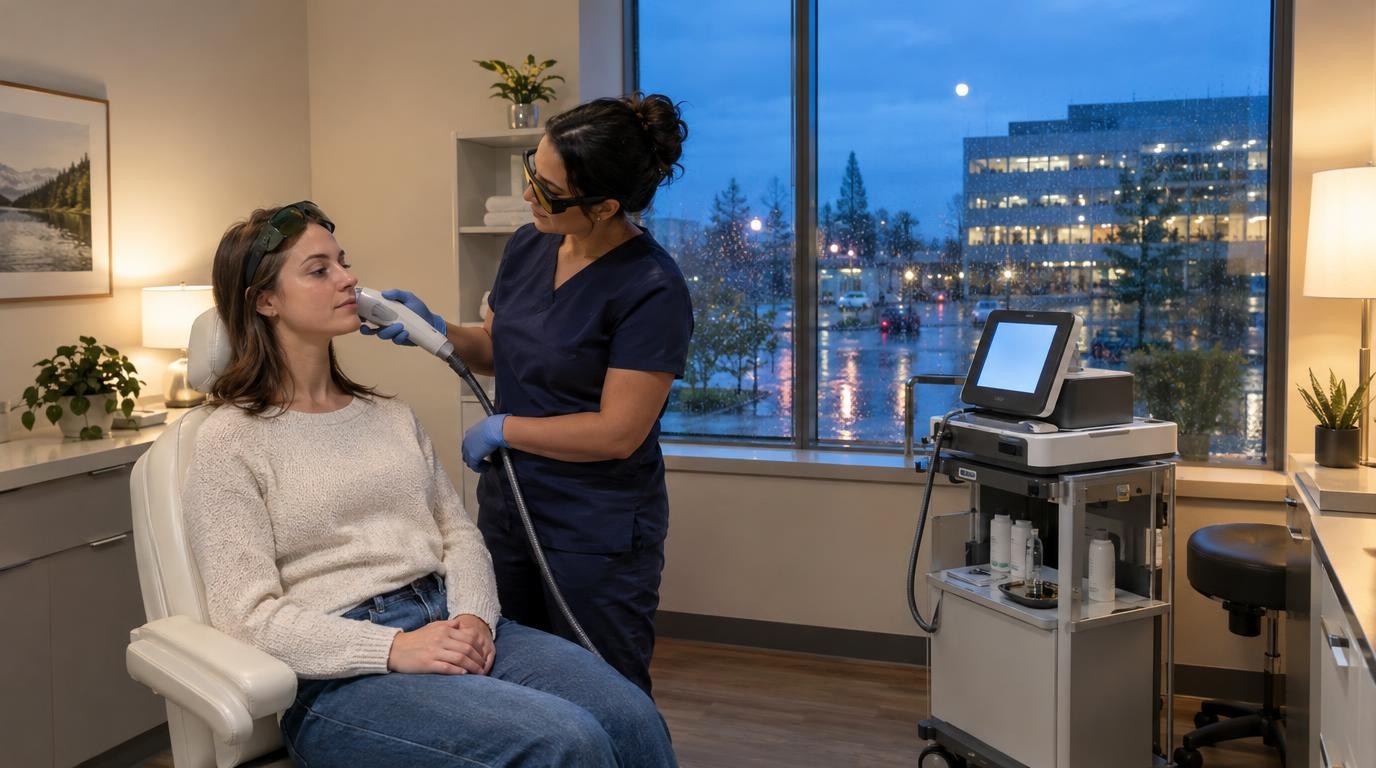
The practical sequence is straightforward, although the exact preparation and treatment details depend on the patient and device:
- Assessment: Identify whether the main concern is skin texture and whether the eye area is suitable for treatment.
- Protection and preparation: Confirm the appropriate ocular protection and comfort measures before laser application.
- Fractional application: Treat the planned skin area with the selected settings.
- Aftercare: Follow instructions for caring for sensitive, renewing skin and protecting it from the sun.
Our general Fraxel protocol uses the following figures; your under-eye plan may differ:
| General Fraxel protocol at NW Laser | What the figure means |
|---|---|
| NW Laser: 20-25% of the desired area during an initial session | A service-page description of fractional coverage, not a promised under-eye setting. |
| NW Laser: typically 4-5 treatments | A general recommendation that may not fit an individual eye-area plan. |
How Are the Eyes Protected During Periocular Laser Treatment?
For treatment near the eyelids, the clinician selects protective eye shields appropriate to the laser and treatment area. The American Society of Plastic Surgeons’ resurfacing procedure guidance includes eye protection during preparation. Shields must be selected and handled correctly; they do not replace careful laser technique.
How Long Does Under-Eye Laser Recovery Take?
Specialists quoted in the American Academy of Ophthalmology’s October 2024 oculoplastics update estimate about two weeks of healing after periocular CO2 resurfacing; healing can take months for some patients treated over broader areas. Recovery varies with the device, whether treatment is ablative, the settings and individual healing. Redness, swelling, sensitivity and visible skin renewal can follow resurfacing. Fractional treatment leaves untreated skin between treated zones, but that design does not guarantee brief downtime.
The CO2 estimates do not establish a recovery schedule for our Fraxel treatment; its device model, settings and your treatment plan matter. Follow your aftercare instructions and protect healing skin from the sun.
How Do Fractional CO2 and Other Fraxel Treatments Differ in Downtime?
Fractional CO2 is ablative within its treated zones and requires healing time. If a different fractional treatment is confirmed to be nonablative, it generally involves less downtime than ablative CO2. Full-field ablative CO2 covers the surface more continuously and generally involves a greater healing burden than fractional CO2. We cannot make a specific recovery comparison for our Fraxel treatment until its model and proposed settings are confirmed. Our laser skin resurfacing patient guide lists useful preparation and recovery questions; a comparison of Fraxel and CO2 recovery considerations offers additional educational context.
Earlier studies summarized in a CDC-published report of two infection cases found lower rates of hypopigmentation, scarring and infection with fractional CO2 than with traditional ablative resurfacing. An American Academy of Ophthalmology review also describes less redness and fewer postoperative pigment changes with fractionation. Fractional CO2 still has risks, and these comparisons cannot establish the risk profile of our Fraxel device without identifying its model.
What Are the Risks of CO2 Laser Under the Eyes?
CO2 resurfacing near the eyes can cause expected short-term redness, swelling and sensitivity, but complications are possible. Postinflammatory hyperpigmentation is common after CO2 resurfacing, and redness can persist for several weeks or months; infection, herpes flares, scarring and hypopigmentation are other possible complications. An EyeWiki review of cosmetic-laser injuries describes case reports of corneal ulceration and scarring, iris injury and cataract after periocular CO2 treatment, including injuries involving overheated metal corneal shields. These reports do not show how often such injuries occur; they show why shield handling, training and careful assessment matter.
The CDC report describes two cases of nontuberculous mycobacterial infection after fractional CO2 resurfacing. Clusters of red bumps and pustules appeared in the treated areas within two weeks. These cases show a possible complication; they do not establish how often it occurs.
What Is the Downside of CO2 Laser Resurfacing on the Face?
CO2 resurfacing requires wound care and diligent sun protection while the skin heals. A specialist quoted in the American Academy of Ophthalmology’s oculoplastics update notes that inadequate mineral-based sunscreen use after treatment may increase the risk of postinflammatory hyperpigmentation. More intensive treatment may correct more substantial laxity, but deeper CO2 treatment also increases the risk of hypopigmentation.
Who Should Postpone or Avoid Periocular Laser Treatment?
Active skin infections, including herpes flares, call for postponing treatment. Active acne, certain medications, connective-tissue disorders and a history of poor wound healing warrant screening before CO2 treatment; eye health also matters near the eyelids. Discuss these factors with your own clinician before treatment. Seek urgent medical attention for new vision changes or severe eye pain; promptly contact the treating clinician for worsening redness, fever, pus or clusters of new red bumps or pustules, particularly within two weeks of resurfacing.
What Can Under-Eye Resurfacing Results Actually Show?
Under-eye resurfacing may make texture look smoother and fine lines less noticeable as the skin heals and remodels. A remaining bag does not mean the skin treatment failed: protruding fat is a separate concern. Photographs can help illustrate possible changes, but another patient’s result cannot predict an individual’s outcome.
When reviewing before-and-after images, compare similar lighting, facial expression, camera angles and follow-up intervals. Our before-and-after gallery offers examples to discuss, and our Fraxel before-and-after photo guide explains what to look for when comparing results.
Can You Show Me Pictures of Fractional CO2 Laser Resurfacing Before and After?
The American Society of Plastic Surgeons’ before-and-after gallery case identifies fractional CO2 laser treatment alongside chemical peels and IPL. Because the case lists multiple treatments, its result cannot be attributed to CO2 alone. We also cannot present a Fraxel photograph as a fractional CO2 result unless the device used is verified. For any image, check the treatments performed and compare similar views at stated follow-up points.
How Can You Choose an Under-Eye Treatment in Vancouver, Washington?
Choose an under-eye treatment by identifying the concern first, then matching the method to the anatomy. Fraxel may help fine lines and some discoloration, but it cannot correct hollowing or remove protruding fat. The questions below can help you compare a laser plan with other options.
- Name the main concern: Is the change in texture, color, contour or eyelid tissue?
- Confirm the device: Ask which Fraxel model is used and whether the proposed treatment is appropriate near your eyes.
- Understand protection and recovery: Ask what ocular protection, aftercare and likely healing course apply to the proposed settings.
- Consider the alternative: Ask whether prominent bags or excess eyelid skin warrant a surgical evaluation instead.
Frequently Asked Questions
Does CO2 laser treatment under the eyes hurt?
Yes, CO2 resurfacing can hurt. The skin may be numbed with a local anesthetic, and a sedative may be offered depending on the treatment and your needs. The American Society of Plastic Surgeons describes these comfort measures in its laser resurfacing procedure guidance.
When will I see the final results from CO2 laser under my eyes?
Results can continue developing after the skin initially heals. The American Board of Cosmetic Surgery says collagen remodeling can continue for up to six months after an appropriately aggressive CO2 resurfacing session. Early changes in fine lines are not necessarily the final result; that timeframe does not predict results from our Fraxel treatment.
How long do CO2 laser results under the eyes last?
Improvements may last for years, but they are not permanent. An article on the American Board of Cosmetic Surgery’s website says CO2 results typically endure for years with appropriate skincare and sun avoidance; that general statement is not a guaranteed duration for under-eye results. Skin continues to age, and individual results vary.
Is oozing or bronzing normal after CO2 laser resurfacing under the eyes?
Yes. An article on the American Board of Cosmetic Surgery’s website describes pinpoint oozing, a bronzed appearance and redness as possible changes while treated skin dries and sheds. Follow your aftercare instructions; worsening symptoms need prompt attention.
When can I wear makeup after CO2 laser treatment under my eyes?
A specialist quoted in the American Academy of Ophthalmology’s oculoplastics update says tinted sunscreen and makeup can cover lingering redness two weeks after CO2 treatment. That is not a universal clearance date: wait until the treated skin has healed, and follow your treatment-specific aftercare instructions.
Does full-field CO2 laser tighten under-eye skin more than fractional CO2?
It can. A specialist quoted in the article on the American Academy of Ophthalmology’s site says full-field CO2 can correct more substantial skin laxity than fractional treatment, but deeper treatment carries greater risk. Neither approach removes protruding fat, and more aggressive treatment is not automatically appropriate for delicate eyelid skin.
Can a CO2 laser be used during lower eyelid surgery to treat bags?
Yes, a surgeon may use a CO2 laser to make an incision during lower eyelid surgery, but that is different from resurfacing under-eye skin. An American Academy of Ophthalmology surgical video shows a CO2 laser used for an incision before fat repositioning. The surgical steps address the fat; resurfacing alone does not remove an under-eye bag.
Is CO2 Laser Effective for Nasolabial Folds?
It may soften fine surface lines around a fold, but it should not be expected to erase a pronounced nasolabial fold caused by volume loss or tissue laxity. An FDA clearance for a CO2 laser system includes wrinkles and furrows among its skin-resurfacing indications. Resurfacing treats skin texture; it does not restore the deeper volume or support that shapes a substantial fold.
What Is the Next Step for Crepey Under-Eye Skin?
To discuss the Fraxel service documented at our practice, contact NW Laser in Vancouver, Washington, for a consultation at 360-260-7069. Dr. Max Grishkevich, MD, is our founder and Medical Director. Our team can help you clarify what you want treated and explain the device and treatment plan before you decide.
This information is general and is not medical advice. Talk to a licensed clinician about your own situation before making a treatment decision.
About the doctor at NW Laser
Dr. Max Grishkevich, MD – Founder and Medical Director of NW Laser & Skin Care Center; member of the American Academy of Cosmetic Surgery.
