


Last updated: October 3, 2026
Breast fat augmentation removes your own fat by liposuction and transfers it into the breasts for a typically subtle increase in volume without implants. At NW Laser Clinic in Vancouver, Washington, the goal is natural-looking enhancement, not a guaranteed cup-size change or a substitute for a breast lift.
What is breast fat augmentation?
Breast fat augmentation, also called fat transfer breast augmentation or breast fat grafting, uses liposuction to collect a patient’s fat and injections to add volume to the breasts. The American Society of Plastic Surgeons describes it as an option for people seeking a relatively small increase and natural-looking results. Fat transfer adds volume but does not lift sagging tissue.
Our fat transfer breast augmentation service combines breast contouring with fat removal from a suitable donor area. The change depends on the patient’s anatomy, the available fat, and how much transferred fat remains after healing.
How does using your own fat differ from using breast implants?
Fat transfer uses your own tissue, while implants are silicone- or saline-filled devices. Liposuction may also reshape the donor area. The American Board of Cosmetic Surgery outlines differences in achievable volume and implant monitoring:
| Consideration | Fat transfer | Breast implants |
|---|---|---|
| Size and shape | Usually a modest increase with a natural look and feel; some fat is reabsorbed | Can provide a larger, more structured and predictable increase |
| Procedure | Requires harvestable fat, liposuction and fat injections | Requires placement of an implant, but not fat harvesting |
| Implant monitoring | No implant-rupture checks; routine breast screening still applies | Silicone implants require periodic imaging to check for rupture |
Who is a good candidate for breast fat augmentation?
A good candidate generally wants a modest change in breast size, shape, or contour and has enough harvestable fat for liposuction. Small breasts, breast asymmetry, or lost breast volume may prompt an evaluation. A low body mass index can limit available donor fat, while prior breast cancer treatment or radiation calls for an individualized assessment rather than an assumption of eligibility.
Can fat transfer help with breast asymmetry or lost breast volume?
Fat can be placed strategically to improve a contour difference or add modest fullness to deflated breasts. The American Society of Plastic Surgeons’ breast augmentation guidance identifies volume loss after weight reduction or pregnancy and natural breast asymmetry as reasons people consider augmentation. Complete symmetry is not a realistic guarantee.
Will fat transfer correct mild breast sag?
Added fullness may change how mild breast sag looks, but fat transfer does not tighten loose skin or reposition the breasts like a lift. The Cleveland Clinic’s fat transfer guidance distinguishes slight enlargement from the firming effect of a breast lift. If position rather than volume is the main concern, that distinction matters when considering alternatives.
What happens during breast fat augmentation at the clinic?
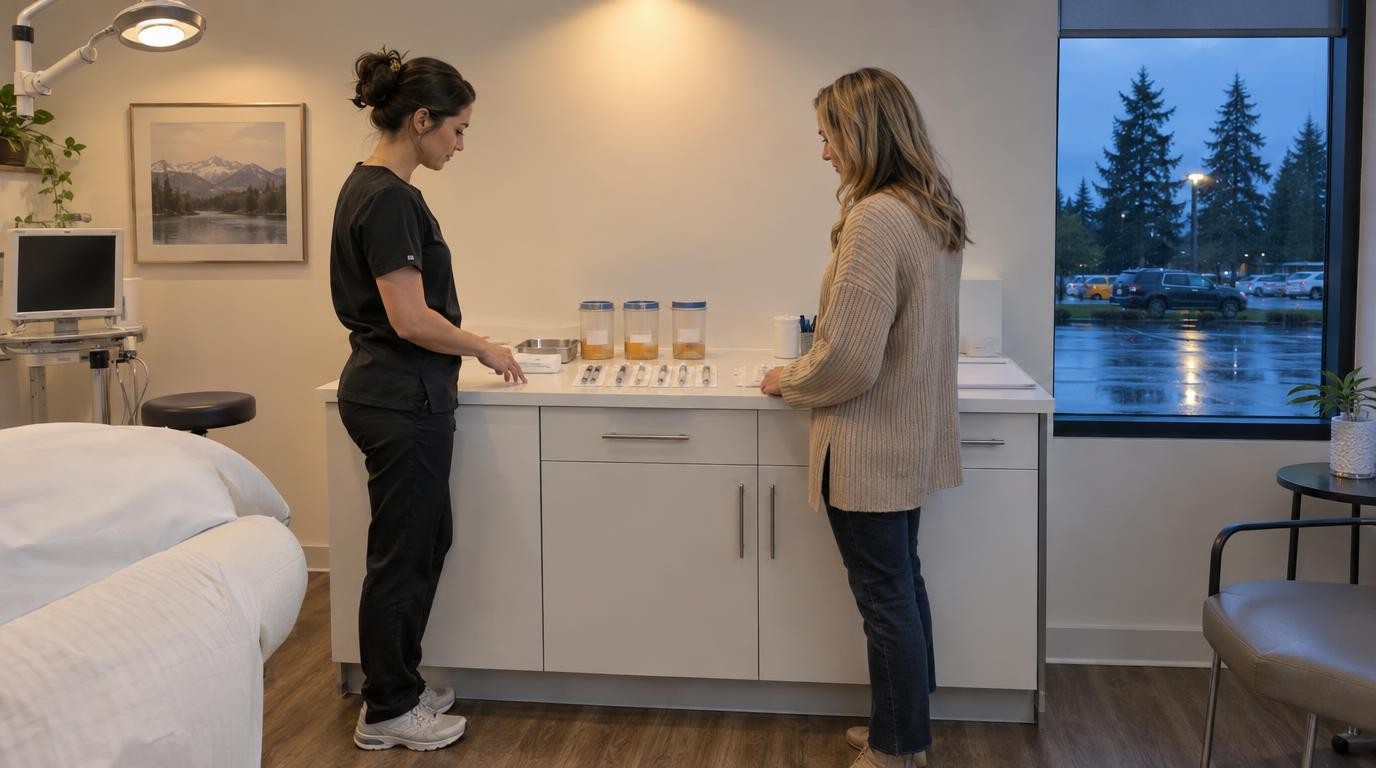
At NW Laser Clinic, breast fat augmentation begins with a medical-history review and breast evaluation, which may include imaging, followed by a discussion of risks and alternatives. Liposuction collects fat from a suitable donor area; the fat is processed and purified before injection into the breasts. Our outpatient procedure takes approximately 2-3 hours.
Where is the fat taken from, and how is it prepared?
Potential donor areas include the abdomen and thighs, depending on where a patient has suitable fat. The procedure follows a sequence:
- Evaluate breast anatomy, health history, and available donor fat.
- Remove fat from the selected area using liposuction.
- Process and purify the collected fat.
- Inject the prepared fat to add breast volume and refine contour.
The evaluation helps determine whether the available fat and expected change match your goals. For related reading, see our guide to fat transfer and natural body contouring.
How much bigger can fat transfer make breasts?
The American Board of Cosmetic Surgery says fat transfer can add up to about 1 cup size, although that result is not guaranteed. Breast size after healing depends partly on how much of the transferred fat survives, and retention varies by patient.
The American Board of Cosmetic Surgery estimates that about 25-50% of transferred fat may fail to take in the breasts and be reabsorbed in the months after surgery. That estimate does not predict an individual result.
Can more than one treatment be needed to reach a desired size?
Yes. Some injected fat does not persist, so an additional procedure may be needed if the healed result falls short of the goal. The Cleveland Clinic notes that dissatisfaction with the result may lead to a recommendation for another fat transfer. Repeat treatment is a possibility to plan for, not a promised way to reach any particular size.
What can the 2026 trial review tell patients about fat transfer?
A 2026 systematic review in Plastic and Reconstructive Surgery Global Open analyzed 9 randomized controlled trials of fat transfer for total breast reconstruction or augmentation. The authors concluded that fat transfer is an effective option for total breast reconstruction and augmentation, but cautioned that limited follow-up prevents definitive conclusions about long-term cancer-related safety.
The review reported the following findings; the comparison with implants concerned reconstruction, not a guarantee about elective cosmetic augmentation.
| Question examined | Review finding |
|---|---|
| Surgical complications | Fat transfer had fewer surgical complications than implant-based reconstruction in the analyzed evidence. |
| Cancer-related safety | Observed outcomes were similar for fat transfer and implant-based reconstruction, with limited long-term follow-up. |
| Fat retention | Enriched fat-transfer techniques improved retention in the analyzed trials; that finding does not describe our clinic’s procedure. |
Does evidence from breast reconstruction apply directly to cosmetic augmentation?
No. Reconstruction and elective augmentation can involve different breast tissue, treatment histories, and goals. Although the review included trials relevant to total augmentation, its reconstruction comparison should not be presented as proof that cosmetic fat transfer has the same complication profile as implant surgery. The findings inform questions to ask, rather than predict an individual’s result.
What is recovery like after breast fat augmentation?
Recovery involves both the liposuction donor area and the breasts. Soreness, bruising, and swelling can occur as the areas heal. Recovery is often shorter than after implant surgery, although activity limits depend on the procedure and individual healing.

When might patients return to work and normal activities?
At NW Laser Clinic, patients can usually return to work and other daily activities within a few days, but this is not a fixed deadline for everyone or every activity. Follow the surgeon’s instructions about work, exercise, and care of both treated areas. At NW Laser Clinic, donor-area compression may be recommended for a few weeks; attend scheduled follow-up visits even if recovery seems straightforward.
Does fat transfer to breasts last forever?
Fat that survives transfer can remain in the breasts for life, but no individual’s breast size or shape is guaranteed to stay unchanged forever. Some fat does not survive the initial healing period, and later weight changes, pregnancy, and aging can affect the result.
Because transferred fat remains part of the body, maintaining a stable weight can help preserve the appearance of the result. For related reading, see our guide to fat transfer results and longevity.
When will the final result be visible?
At NW Laser Clinic, final results may take nearly six months to become visible. Early swelling can make the breasts look fuller, while loss of some transferred fat can change that appearance during healing. Comparing the later result with the original goal is more useful than judging success immediately after the procedure. Our guide to breast augmentation with fat transfer before-and-after photos explains how to assess timing and visible changes.
What are the risks of fat transfer to the breast?
Although serious complications are uncommon, breast fat augmentation is surgery and can cause infection, bleeding or a hematoma, pain, scarring, asymmetry, and fat necrosis. Fat necrosis can create a lump or area of hardness that may need evaluation or further treatment. Some patients need another procedure for their desired contour. Discuss personal risks and suitability with your own clinician before treatment.
Donor-area discomfort and breast swelling are expected recovery concerns, but worsening symptoms deserve attention. Contact the clinic if you develop increasing redness, fever, unexpected bleeding, or a new or worsening breast lump so the team can advise you on evaluation.
Can fat necrosis affect breast imaging?
Yes. Fat necrosis, cysts, or microcalcifications after fat transfer can appear on breast images. Mammograms still work well for most people, but these changes can sometimes prompt further evaluation, including a biopsy. Tell your breast-imaging team that you have had fat transfer, and review your screening history with the surgeon beforehand.
Is a fat transfer breast augmentation worth it?
Fat transfer may be worthwhile if you value a modest, natural-feeling, implant-free enhancement and also welcome contouring of a suitable donor area. The trade-offs are variable fat retention, recovery at both treated areas, and a possible repeat procedure. Whether those trade-offs fit your goals matters more than a promise of a particular cup size.
When might breast implants be a better option?
Implants may be a better option if you want a larger volume increase than fat transfer is likely to provide. A lift addresses a different goal if sagging is the chief concern.
Frequently Asked Questions
How much of the fat transferred to my breasts survives?
There is no guaranteed retention rate. The American Society of Plastic Surgeons cites approximately 50 to 70 percent retention across fat grafting studies in the body, not a prediction for an individual breast procedure. Some fat is reabsorbed, so we assess lasting breast volume after healing.
Will the liposuction part of breast fat augmentation help me lose weight?
No. Liposuction for breast fat augmentation collects fat to add volume to the breasts; it is not a weight-loss procedure. The donor area may look smaller or more contoured, but Cleveland Clinic notes that fat transfer does not create a drastic change where fat is removed.
Can breast fat transfer add cleavage or fullness to the upper breasts?
Yes. Fat can be placed strategically to add cleavage or soften a deflated upper-breast contour, although lasting fullness varies. Fat transfer cannot reliably create the pronounced, structured roundness associated with implants or lift sagging breasts.
Will I need breast implant MRIs if I choose fat transfer?
No. Fat transfer does not place an implant, so routine checks for silicone-filled implants do not apply. You still need appropriate breast screening, and mammograms generally remain useful after fat transfer. Tell your imaging team about the procedure because changes such as microcalcifications or cysts may appear on breast images.
Does fat transfer to the breasts increase breast cancer risk?
Current evidence has not shown an increased breast cancer risk after fat transfer, but the available trials have limited follow-up. Definitive conclusions about long-term cancer-related safety are not yet possible.
Can breast fat transfer be done with a breast lift or implants?
Yes. Surgeons sometimes combine fat transfer with a lift or implants. Fat can refine breast contour while a lift addresses position or implants provide more volume. Whether a combined procedure is appropriate depends on your anatomy and goals.
What should you ask at a breast fat augmentation consultation?
- Which donor areas are suitable, and what change might liposuction make there?
- What breast-volume or symmetry improvement is realistic after healing?
- How should prior imaging, breast screening, cancer treatment, or radiation affect the plan?
- What recovery instructions and follow-up visits should I expect?
- What is the plan if a lump develops or the retained volume is less than hoped?
If subtle enhancement with your own fat sounds aligned with your goals, contact NW Laser Clinic in Vancouver, Washington, for a consultation. Our team can evaluate your anatomy and history, explain the likely trade-offs, and help you decide whether breast fat augmentation is an appropriate choice.
This information is general and is not medical advice. Talk to a licensed clinician about your own situation before making a treatment decision.
