

Last updated: November 9, 2026
A fractional CO2 laser is an ablative resurfacing laser that treats microscopic columns of skin while leaving surrounding skin untreated. We offer Fraxel laser treatment at NW Laser in Vancouver, Washington, but Fraxel is a brand, not another name for fractional CO2; the laser type depends on the device model.
What Is a Fractional CO2 Laser and How Does It Work?
A fractional CO2 laser removes tissue in microscopic columns rather than treating the entire skin surface uniformly. Untreated skin remains between the columns, while the controlled injury prompts healing and collagen remodeling. The treatment can improve skin texture, but the extent of improvement and healing depends on the person and the settings used.
Cleveland Clinic’s laser skin resurfacing guidance explains that fractional CO2 energy penetrates narrow columns while the surrounding skin remains intact. The healing response can contract existing collagen and encourage new collagen formation. Because the columns may extend deeply, fractional treatment still carries a risk of difficult healing and scarring.
How Is Fractional CO2 Different From Traditional CO2 Resurfacing?
Johns Hopkins Medicine explains that fractional delivery treats only part of the selected area and may shorten recovery compared with full-field treatment. The two approaches differ as follows:
| CO2 resurfacing approach | Skin treated | Recovery comparison |
|---|---|---|
| Traditional full-field | The skin surface across the selected area | Generally longer than with fractional treatment |
| Fractional | Spaced microscopic columns, with skin between them left untreated | May be shorter, although difficult healing and scarring remain possible |
“Fractional” describes a delivery pattern, not the laser type: both CO2 and other lasers can deliver fractional treatment.
What Can Fractional CO2 Laser Resurfacing Improve?
Fractional CO2 laser resurfacing may soften fine lines, improve rough texture and reduce the appearance of some scars and sun-related changes. Results depend on the concern being treated, skin characteristics and treatment settings. Skin-firming effects are possible, but resurfacing should not be mistaken for a treatment that corrects substantial sagging.
CO2 resurfacing works by removing damaged surface tissue and stimulating a healing response. That makes it a potential option for facial acne scars and uneven skin, although a scar’s shape and depth affect what improvement is realistic. Sun spots and uneven tone may call for different approaches: our IPL photofacial versus fractional laser comparison addresses two options, while identifying the cause of discoloration remains important before treatment.
A CO2 resurfacing guide from the American Board of Cosmetic Surgery says results typically endure for years when paired with proper skin care and sun avoidance. Individual results vary, and ongoing skin care and sun protection affect how long improvements remain visible.
Mayo Clinic’s laser resurfacing guidance says more than one session is likely with fractional laser resurfacing. The number of fractional CO2 sessions, if needed, depends on your goals and treatment plan; our Fraxel schedule does not define it.
Does CO2 Laser Actually Tighten Skin?
Fractional CO2 treatment can produce some firming as collagen contracts and remodels. The effect is not equivalent to lifting significantly loose skin: Mayo Clinic states that resurfacing cannot fix sagging skin. If laxity is your main concern, distinguish improvement in skin quality from a change in facial contours when discussing your goals.
Can Fractional CO2 Help Acne Scars, Sun Spots, or Melasma?
Laser resurfacing acne scars or sun-damaged skin may improve their appearance, but melasma needs particular care. Melasma can recur, and laser-related irritation or pigment change may make discoloration worse for some people. The treatment choice should account for the cause of the pigment, your skin tone and any history of darkening after inflammation.
Is NW Laser’s Fraxel Treatment the Same as Fractional CO2?
Our Fraxel treatment should not be assumed to be fractional CO2: the Fraxel name alone does not establish which laser type or model would be used. We offer Fraxel, a Solta Medical fractional-laser brand, for concerns including wrinkles, uneven tone and scars. The specific model and whether your proposed treatment is CO2-based and ablative need to be confirmed at your consultation.
A recovery estimate for ablative CO2 resurfacing should not automatically be applied to a nonablative fractional treatment. Our Fraxel versus CO2 resurfacing comparison offers further context for comparing the terms.
What Are Some Brands of Fractional Lasers?
An article on the American Board of Cosmetic Surgery’s site lists AcuPulse, MiXto Pro and CO2RE as examples of CO2 laser brands, and Fraxel and Fractora as fractional-laser brands. These categories describe different things: CO2 identifies a laser type, while fractional identifies how its energy is delivered.
How Can You Confirm Which Laser NW Laser Uses?
The precise Fraxel model and wavelength identify the laser used. Whether the planned treatment removes surface tissue establishes if it is ablative; together, these details distinguish fractional CO2 resurfacing from other fractional treatments.
Who May Be a Candidate for Fractional CO2 Resurfacing?
A potential fractional CO2 candidate has a concern the treatment may improve and can follow the preparation and aftercare required for ablative resurfacing. Suitability also depends on skin tone, pigment history, medical history and treatment goals. A good match cannot be determined from a device name or a photograph alone. Fraxel laser before and after photos can show visible changes, but they cannot establish your likely results or treatment suitability.
The American Board of Cosmetic Surgery’s CO2 resurfacing guide identifies active acne, certain medications, connective-tissue disorders and a history of poor wound healing as factors to screen for before CO2 resurfacing. These can affect whether ablative treatment is appropriate, even when the skin concern itself could improve.
How Do Skin Tone and Treatment Goals Affect the Decision?
Skin tone can affect the risk of post-treatment pigment changes and the choice of settings. The 2025 expert consensus on fractional ablative CO2 facial rejuvenation, developed by dermatologists and plastic surgeons, reports that over 90% of its panel recommended changing settings for Fitzpatrick skin types III-IV. That is a report of panel practice, not a rule that excludes other skin tones. Darker skin is not automatically excluded from resurfacing, but the risk of post-treatment pigment changes deserves particular attention. Your main goal matters, too: etched-in lines or acne scars may make resurfacing worth considering, while correcting substantial sagging calls for discussing a different approach.
How Do You Prepare for CO2 Laser Treatment?
Before CO2 laser treatment, review your medicines and health history with your clinician, avoid sun exposure and follow the skin-preparation instructions chosen for you. Disclose cold sores or other infections, recent sun exposure, prior pigment problems, and whether you are pregnant or breastfeeding. Cleveland Clinic’s carbon dioxide laser resurfacing guidance advises avoiding sun exposure for four weeks before treatment and using sunscreen before and after resurfacing; apply sunscreen to newly treated skin only after it heals. Do not change prescribed medicines independently.
The American Society of Plastic Surgeons’ procedure guidance says preparatory skin treatments sometimes begin six weeks or more before laser resurfacing. That is not a required schedule for every fractional CO2 treatment; preparation depends on the planned procedure and skin history.
What Is the Procedure for Fractional CO2 Laser Treatment?
At a fractional CO2 appointment, the team cleanses your skin and protects your eyes, provides pain control, makes the planned laser passes, then protects treated skin and reviews wound care. The exact pain-control and infection-prevention measures depend on your history and treatment plan rather than one required protocol.
- Review the treatment area, goals, risks and consent.
- Cleanse the skin and place appropriate eye protection.
- Provide the selected method of pain control.
- Make planned fractional laser passes using settings chosen for the skin and treatment goal.
- Protect the treated skin and explain wound care, follow-up and warning signs.
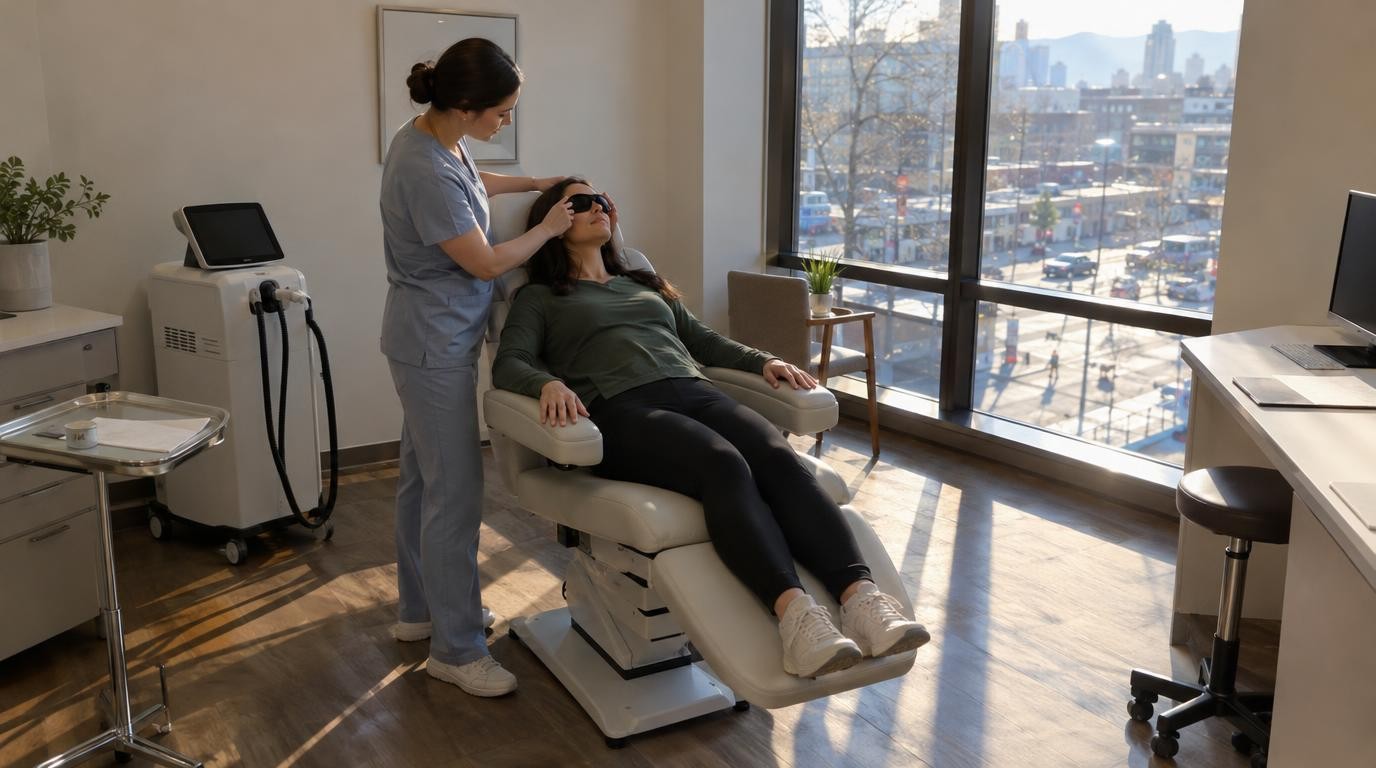
The American Society of Plastic Surgeons says laser resurfacing is usually an outpatient procedure lasting 30 minutes to two hours overall. The steps above describe fractional CO2 care generally, not a specified protocol for our Fraxel treatment.
What Pain Control and Infection Prevention Should You Discuss?
The 2025 expert consensus reports the following pain-control and infection-prevention practices among its panelists. These survey responses are not universal requirements or a protocol for our Fraxel treatment.
| 2025 expert consensus panel practice | Reported panel response |
|---|---|
| Topical anesthetic cream | 95% of panelists |
| Nerve blocks | 81% of panelists |
| Oral analgesics | 62% of panelists |
| Bacterial and viral prophylaxis | Over 90% of panelists used both |
How Long Does Fractional CO2 Laser Recovery Take?
Cleveland Clinic estimates one full week of recovery after fractional laser resurfacing, but fractional CO2 surface healing can take longer. Treatment depth, settings, skin response and aftercare affect timing; redness and swelling may accompany healing, and visible redness can outlast it.
Cleveland Clinic separately estimates that treated areas generally heal in 10 to 21 days after CO2 resurfacing, depending on the condition treated and laser intensity. The 2025 expert consensus reports reepithelialization — formation of a new skin surface — between 8 and 42 days after fractional ablative CO2 treatment. These estimates describe different aspects of recovery, not an individual healing forecast or a timetable for our Fraxel treatment.
The American Board of Cosmetic Surgery’s CO2 aftercare guidance describes saline compresses every few hours for the first 48–72 hours and keeping treated skin covered with an occlusive ointment until peeling is complete. Your written instructions for the device and settings used take priority; our facial laser recovery guide offers additional context.
At NW Laser, we estimate that 20–25% of the desired area can be resurfaced during the first Fraxel procedure, and we typically recommend 4–5 treatments for optimal results. These are our Fraxel treatment figures, not a fractional CO2 session plan.
What Should You Ask About Healing and Follow-Up?
Ask what healing should look like at each stage, how to cleanse and dress the treated skin, and when your team will check your progress. Confirm which number to call during business hours or after hours if healing concerns arise, and whether you may need dressing changes or an additional check if healing is delayed.
What Are the Risks and Contraindications of Fractional CO2 Laser?
Fractional CO2 resurfacing commonly causes temporary redness and swelling and can also lead to infection, unwanted pigment changes or scarring. Risk depends on the person, settings and healing conditions.
The CDC’s report on infection after fractionated CO2 resurfacing says studies found lower rates of hypopigmentation, scarring and infectious complications than with traditional ablative resurfacing. Lower risk does not mean no risk, and those findings do not provide a percentage for your individual risk.
The 2025 expert consensus panel reported these views on when treatment should be deferred. The percentages describe panel responses, not universal eligibility rules.
| 2025 expert consensus panel finding | Reported panel response |
|---|---|
| Active facial infection considered a contraindication | 95% of panelists |
| Burns, recent sun exposure, and pregnancy or breastfeeding considered contraindications | 67% of panelists |
Pigment changes may be especially important to discuss if you have darker skin or a history of dark marks after inflammation. Seek prompt medical advice for worsening pain, spreading redness, fever or discharge after resurfacing. Discuss your personal risks and whether to postpone treatment with your own qualified clinician.
When Should You Postpone Laser Resurfacing?
Postpone resurfacing if the treatment area has an active infection or burn. Avoid sun exposure for four weeks before laser treatment, as Cleveland Clinic advises. Pregnancy or breastfeeding was considered a reason to defer fractional ablative CO2 treatment by 67% of the expert panel; a new skin problem or change in medicines also calls for reassessing the plan.
How Do You Choose a Fractional CO2 Laser Provider?
Choose a provider who can identify the exact device, explain why its settings suit your skin, describe pain control and infection prevention, and provide a clear follow-up plan. Experience includes recognizing when the requested laser is a poor match. For our Fraxel treatment, the model, proposed settings and expected healing should be clear before a treatment plan is agreed upon.
The 2025 expert consensus offers a framework for patient questions, but its authors noted a modest panel size and a focus on a specific device. Its recommendations came from a survey of 188 questions answered by 21 dermatologists and plastic surgeons, followed by 11 questions intended to resolve gaps. The panel also reported that 67% did not prescribe antifungal prophylaxis, illustrating why prevention plans should be explained rather than assumed to be identical.
What Should You Ask About Laser Settings and Safety Protocols?
- Who will assess your skin and perform the treatment, and what is their training with the device?
- What is the device model, and is the proposed treatment fractional, ablative and CO2-based?
- How will treatment density and other settings account for your skin tone, pigment history and goals?
- What pain-control, eye-protection and infection-prevention measures are planned?
- What written aftercare and follow-up will you receive?
Clear answers matter more than a broad claim that a laser is suitable for everyone. They also make it easier to compare a proposed procedure with the recovery and risks you are willing to accept.
What Should You Ask at a Vancouver, Washington Consultation?
At a free consultation with our Vancouver, Washington team, ask which Fraxel model we would use for your concern and whether your proposed treatment is CO2-based and ablative. Ask how many sessions we recommend for you, how far apart we would schedule them, and what recovery to plan for after each. If you are weighing another provider’s treatment, a Fraxel versus CO2 recovery and results comparison can help you frame your questions.
Frequently Asked Questions
How should I clean my skin after CO2 laser resurfacing?
Cleveland Clinic’s CO2 resurfacing instructions describe a nonstick dressing for the first 24 hours, followed by cleansing with saline or dilute vinegar two to five times daily and applying an ointment to keep the skin moist. Wound-care instructions can differ with the condition treated and laser intensity.
When can I use retinoids or exfoliating acids after CO2 laser treatment?
Cleveland Clinic says Retin-A or glycolic acid products may generally be resumed approximately six weeks after CO2 resurfacing, or as directed in your aftercare plan. The timing depends on healing; avoid restarting irritating products while the treated skin is still recovering.
When should I start using sunscreen after CO2 laser resurfacing?
Start applying sunscreen to the treated area after the skin has healed. Cleveland Clinic recommends daily broad-spectrum facial sunscreen with an SPF of at least 30 at that point. Keep newly treated skin protected from sun exposure while it heals.
How long does a fractional CO2 laser appointment take?
The American Society of Plastic Surgeons gives 30 minutes to two hours as the typical duration of an outpatient laser resurfacing procedure; that range is not specific to every fractional CO2 appointment. The time needed depends on the treatment area and plan, including preparation and pain control.
Do I need antiviral medication before fractional CO2 laser treatment if I get cold sores?
A history of cold sores matters because laser resurfacing can trigger herpes simplex outbreaks. In the 2025 expert consensus survey, more than 90% of panelists used viral prophylaxis, but that does not mean everyone needs an antiviral. Prevention depends on the patient’s history and the planned treatment; do not start medication solely on the basis of the survey.
Is erbium laser resurfacing an option for darker skin tones?
Yes, erbium resurfacing may be an option. Cleveland Clinic notes that it can cause fewer side effects than CO2 resurfacing and may be a good choice for someone with a darker skin tone. Erbium is not risk-free; pigment history, treatment goals and expected recovery still matter.
Is IPL the same treatment as fractional CO2 laser resurfacing?
No. IPL uses intense pulsed light and is not technically a laser; fractional CO2 is an ablative laser treatment that removes tissue in microscopic columns. An article on the American Board of Cosmetic Surgery’s site notes that IPL is often used for concerns such as sun damage, redness and pigmentation. Which approach fits depends on the cause of the skin concern.
How Can You Make a Confident Resurfacing Decision?
A resurfacing decision weighs the expected improvement against healing time and the possibility of pigment changes or scarring. For some patients, a nonablative fractional laser offers a different balance of improvement and recovery than ablative fractional CO2.
To discuss whether Fraxel treatment matches your goals, contact NW Laser in Vancouver, Washington for a free consultation at 360-260-7069.
This information is general and is not medical advice. Talk to a licensed clinician about your own situation before making a treatment decision.
