

Last updated: November 18, 2026
Do lipolysis injections work? Some can reduce small, targeted fat deposits, but they are for contouring, not weight loss. At NW Laser in Vancouver, Washington, our Lipodissolve treatment uses soy-derived phosphatidylcholine. It is different from Kybella, the FDA-approved deoxycholic acid injection for fat beneath the chin.
Do fat dissolving injections work for localized fat?
Fat dissolving injections can improve a localized contour, but the evidence depends on the product and treatment area. The strongest established U.S. evidence concerns deoxycholic acid injections beneath the chin. A 2026 systematic review of injections for fat outside the under-chin area included 25 studies and 3,178 patients. Reductions in localized fat were reported in 93.75% of studies, but 37.5% reported a statistically significant reduction. The authors called for further trials to establish treatment protocols and long-term effectiveness. These findings across different agents and body areas do not predict a patient’s result from a particular injection.
What results can patients realistically expect?
Expect a possible improvement in shape, not a substantial change on the scale. The amount of visible improvement varies with the starting fat deposit, skin condition, product, and response to treatment. In clinical practice, defining the specific contour you hope to change is more useful than asking whether an injection will remove fat generally.
Does the evidence differ between a double chin and belly fat?
Yes. Kybella is FDA-approved for fat beneath the chin; it is not approved for belly fat. CBL-514 is among the agents investigated for fat reduction outside the under-chin area, but findings for that agent cannot predict results or risks from our Lipodissolve treatment. For abdominal contour, you can also review surgical and non-surgical options for excess abdominal fat.
How do fat dissolving injections affect fat cells?
Injection lipolysis aims to reduce fat near the injection sites, but the substance matters. Kybella’s deoxycholic acid disrupts fat-cell membranes. Our Lipodissolve treatment uses soy-derived phosphatidylcholine, which we describe as helping to emulsify and break down fat deposits when injected into them. Phosphatidylcholine also occurs naturally in the body, but neither that fact nor our description of its intended action establishes the safety or effectiveness of the injected formulation. Some other lipolysis formulations combine phosphatidylcholine with deoxycholate.
Which fat dissolving injections are FDA-approved in the United States?
According to the FDA’s guidance on fat-dissolving injections, Kybella is the only FDA-approved injectable drug for reducing fat beneath the chin in adults. Its approval does not extend to the stomach, thighs, love handles, or other body areas. Lipodissolve is not an FDA-approved product; formulations sold under that name have not been evaluated by the FDA for safety or effectiveness.
Is Lipodissolve the same thing as Kybella?
No. Kybella is a specific prescription deoxycholic acid product. Our Lipodissolve treatment uses soy-derived phosphatidylcholine; other products sold as Lipodissolve may contain phosphatidylcholine, sodium deoxycholate, or both. None is interchangeable with Kybella’s FDA-approved formulation. At NW Laser, we describe the chin, stomach, upper arms, thighs, hips, armpit fat, and knees as possible areas for Lipodissolve. These are descriptions of our service, not FDA-approved uses or a promise of benefit in any of those areas. Our Lipodissolve injections article offers further context.
Are fat dissolving injections approved for love handles, thighs, or belly fat?
Kybella is not FDA-approved for love handles, thighs, the abdomen, or arms; using it in those areas would be off-label. Research on fat-dissolving agents outside the chin does not establish Lipodissolve’s effectiveness for a particular body area. Evidence for each product and proposed treatment area must be considered separately.
How many fat dissolving injections do I need for my stomach?
There is no established session count for stomach Lipodissolve injections, and no fat-dissolving injection is FDA-approved for abdominal fat. In a 2018 retrospective series of 1,269 patients treated in various areas with a phosphatidylcholine–deoxycholate combination, patients received an average of four sessions every four weeks; results were assessed eight weeks after the last session. The authors said effects were best appreciated on the face and upper arms and were average on the thighs and around the knees. This retrospective study of a combination formulation does not establish a schedule for our treatment or predict an individual’s abdominal result.
What are the best fat dissolving injections for belly fat?
There is no FDA-approved fat-dissolving injection for belly fat. Kybella’s evidence and approval concern the area beneath the chin, while studies of other agents or formulations do not establish a best abdominal injection.
Can you buy fat removal injections online and inject them yourself?
Do not buy Lipodissolve or other fat removal injections online to self-inject. The FDA has received reports of infections, scars, and other injuries after use of unapproved fat-dissolving injections. An injectable’s ingredients, appropriate placement, and potential complications require professional assessment and administration.
Who is a good candidate for fat dissolving injections?
A potential candidate has a modest, localized fat deposit and wants a contour change rather than weight loss. Anatomy, skin condition, medical history, and the proposed product also matter. Loose skin or poor skin tone may make under-chin injection lipolysis a poor fit, because reducing fat does not remove excess skin.
Who cannot have fat dissolving injections?
Kybella must not be injected where there is an active infection; this is its labeled contraindication. Before treatment, tell your clinician if you take antiplatelet medicines or anticoagulants (blood thinners), or have a coagulation disorder: Kybella’s label cautions that excessive bruising or bleeding may occur. Pregnancy or breastfeeding, difficulty swallowing, and prior procedures near the treatment area also warrant individual review. These considerations are not all labeled contraindications.
Can injections address cellulite, loose skin, or overall weight?
Fat reduction does not directly treat overall weight, and removing fat may not resolve loose skin or the skin texture changes associated with cellulite. If texture or skin firmness is the main concern, say so during the consultation. A different treatment category may better address that goal.
What happens during a fat dissolving injection appointment?
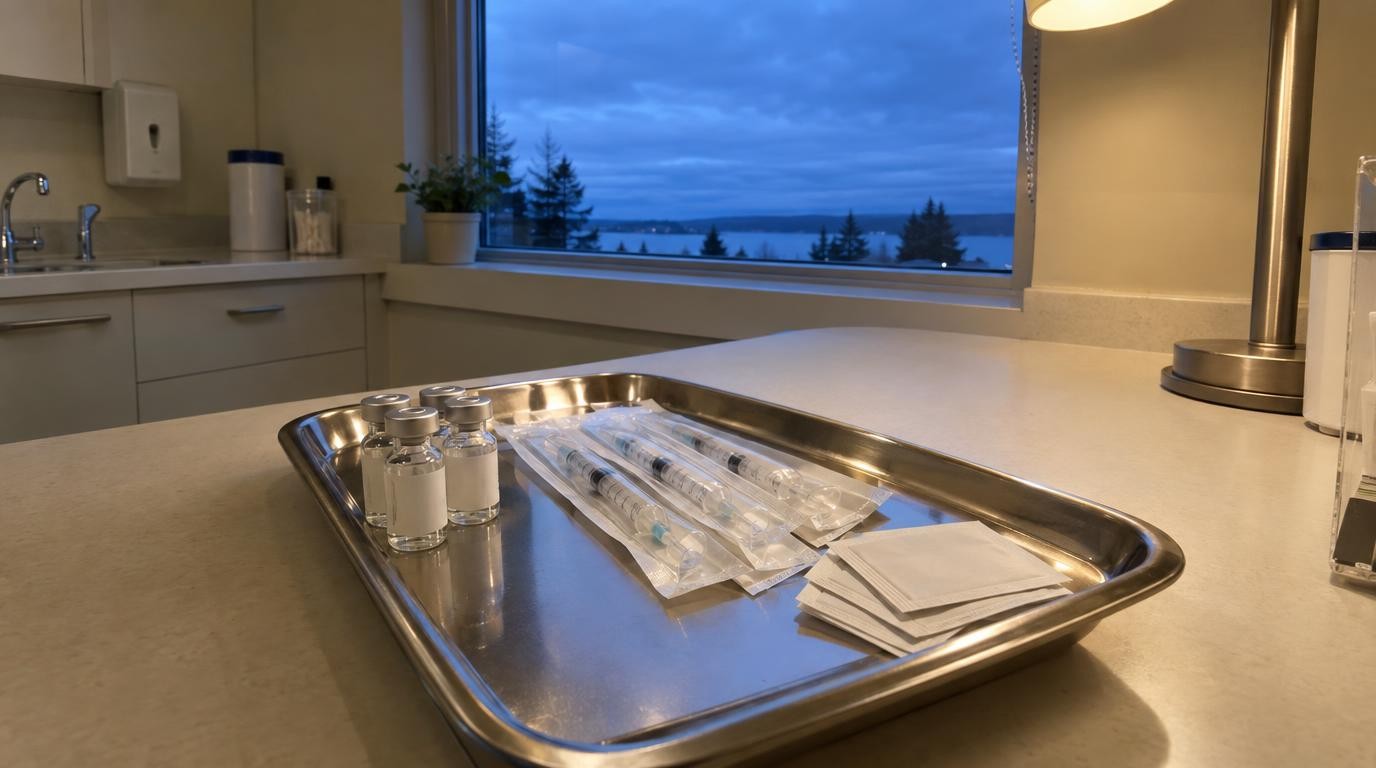
The product and intended area should be confirmed before any injections. For Kybella beneath the chin, the American Society of Plastic Surgeons describes this sequence:
- Assess the under-chin fullness and mark a precise grid on the skin.
- Give local anesthesia, if used.
- Inject measured amounts of medication in the marked grid.
For our Lipodissolve treatment, we inject the product directly into the targeted fat deposit. Its injection plan and expected recovery should not be assumed to match Kybella’s.
How is the treatment area assessed before injections?
Fullness can come from pinchable fat beneath the skin, loose skin, or another feature. Abdominal fat deeper than the muscles is also different from the superficial deposit an injection targets. Identifying the cause helps distinguish a concern injections could address from one they cannot.
What should you expect during recovery?
Temporary swelling, bruising, tenderness, firmness, or numbness can affect the treated area. The American Academy of Dermatology notes that some people have marked swelling for as long as two weeks after injections for under-chin fat, although most can return to everyday activities immediately. Swelling can make the area look fuller before improvement becomes visible.
When do results appear, and how many sessions might you need?
Results become clearer as swelling settles. For deoxycholic acid beneath the chin, the American Society of Plastic Surgeons says most patients see improvement six to eight weeks after a treatment. The American Academy of Dermatology says the full effect of under-chin injections is usually visible about three to four months after the last treatment. Neither timeline establishes when a different Lipodissolve formulation or body area will improve.
Do fat dissolving injections work after one session?
Some people may notice a change after one Kybella session, but most patients receive at least two treatments. Swelling can temporarily make the contour look fuller, so an immediate or complete result after one visit is not a sound expectation.
How many Kybella sessions might a double chin require?
For Kybella beneath the chin, the American Society of Plastic Surgeons says most patients have at least two treatments spaced four to six weeks apart, and patients can have up to six treatments. That schedule does not apply automatically to Lipodissolve or to belly fat.
How long can results last if your weight changes?
Deoxycholic acid destroys treated fat cells, so an under-chin improvement can be long-lasting. Remaining fat cells can still enlarge with weight gain, changing the contour again. The duration of results from other injectable formulations is less certain.
How do fat dissolving injections compare with other fat reduction options?
Injections may suit a small, well-defined deposit, while liposuction can produce a more substantial contour change. As the American Society of Plastic Surgeons explains, nonsurgical fat-reduction methods are not replacements for liposuction. The main differences are:
| Option | Where it fits | Key consideration |
|---|---|---|
| Kybella | Fat beneath the chin in adults | FDA-approved for that area; usually requires multiple sessions and can cause visible swelling |
| Lipodissolve | Proposed treatment of small, localized deposits | Not FDA-approved; evidence and risks depend on the exact formulation and area |
| Device-based fat reduction | Selected localized deposits, depending on the device | Uses methods such as heating or cooling rather than an injection; results are generally subtler than liposuction |
| Liposuction | Deposits needing a more substantial contour change | Surgically removes fat and requires recovery |

What is the safest procedure to remove belly fat?
There is no single safest procedure for every person with abdominal fullness. Pinchable subcutaneous fat, loose skin, and fat deeper inside the abdomen are different concerns; injections into a superficial deposit do not address them all. Surgery also has a different recovery: MedlinePlus’s liposuction guide says patients may return to work within a few days, while bruising and swelling usually resolve within three weeks and some swelling can last several months.
When might liposuction or another approach be a better fit?
Liposuction removes fat by suction and may be a better fit when the desired change is beyond what a small-area injection could reasonably achieve. At NW Laser, we also offer Vaser liposuction, tumescent liposuction, Emsculpt, and Kybella. For a closer look at chin-specific evidence, see the science behind Kybella for a double chin.
How can you decide whether fat dissolving injections fit your goals?
Start by naming the contour you want to change and identifying the exact product proposed. Its FDA status and evidence for that body area matter more than the general label “fat dissolving.” Compare the likely degree of improvement, number of visits, recovery, risks, and alternatives.
What should you ask about the product, treatment area, and supporting evidence?
- What are the product’s name and ingredients, and is the product FDA-approved for this use, used off-label, or not FDA-approved?
- What evidence addresses this particular area rather than a different part of the body?
- What change is realistic, and how will progress be assessed?
- What side effects, warning signs, recovery needs, and alternative treatments should I consider?
How can a consultation in Vancouver, Washington, clarify your options?
For patients in Vancouver, Washington, the useful distinction is whether the contour comes from a small, superficial fat deposit, loose skin, cellulite, or another cause. Lipolysis injections target fat near their injection sites; they do not treat every source of fullness or skin texture change.
Risks, Side Effects and Who Is Not a Candidate
Fat dissolving injections have meaningful risks as well as potential contour benefits. With Kybella, common effects include swelling, bruising, pain, numbness, redness, and firmness. The Kybella prescribing information reports injection-site hematoma or bruising in 72% of treated clinical-trial participants; injection-site numbness lasted more than 30 days in 42%. More serious or less-common risks include nerve injury that can make the smile uneven, difficulty swallowing, injection-site ulcers, tissue death, infection, and hair loss at the injection site. The label also warns that injection near salivary glands, lymph nodes, or muscles can damage tissue, and inadvertent injection into an artery or vein can cause vascular injury.
Some Kybella-related effects can persist. An FDA safety communication identified 117 reports of unresolved nodules or masses after deoxycholic acid injections. Among those reported unresolved cases, the nodules or masses had been present for a mean of 143 days at the time of reporting. These reports are not an incidence rate or a prediction of how long a patient’s symptoms will last.
Lipodissolve and other unapproved phosphatidylcholine or deoxycholate formulations need their own risk discussion; Kybella’s trial percentages do not apply to them. The FDA describes a case of infected injection-site knots after Lipodissolve, with lesions still discolored or scar-like two months later. An American Society of Plastic Surgeons policy statement on mesotherapy and injection lipolysis also lists reported abscesses, skin ulcers, and atypical mycobacterial infections. The safety and effectiveness of unapproved Lipodissolve formulations have not been evaluated by the FDA.
Contact your treating clinician promptly if your smile becomes uneven or you develop an open sore, worsening redness or pain, or drainage from an injection site. Seek urgent medical care for difficulty swallowing or new vision changes. The FDA has also warned of serious reported injuries when deoxycholic acid was injected outside its approved under-chin area, including vision changes and muscle or nerve damage. Discuss the risks of the exact product and treatment area proposed for you.
Are fat dissolving injections the right next step for you?
Fat dissolving injections can work for selected localized deposits, but the product and treatment area determine how much confidence to place in a claim. If you want to explore treatment for a double chin, belly fat, or another contour concern, contact NW Laser in Vancouver, Washington, for a consultation about your options.
Frequently Asked Questions
Should I stop my usual medicines before a lipolysis appointment?
Do not stop prescribed medicines on your own for a cosmetic treatment. Bring a current medicine list to your consultation, including any antiplatelet medicines or blood thinners, so your treating clinician can review bleeding and bruising risks before making a plan.
Can I get fat dissolving injections right before a special event?
Plan well ahead rather than relying on a treatment immediately before the event. Swelling or bruising may be visible, and the area may temporarily look fuller. Ask your treating clinician how much time to allow for the particular product and area you are considering.
What if I have a soy allergy?
Tell our team before considering Lipodissolve. The phosphatidylcholine described for our treatment is derived from soybeans, so your allergy history and the exact formulation need individual review. Do not assume the injection is suitable simply because phosphatidylcholine also occurs naturally in the body.
What if a lump does not go away after Kybella?
Contact your treating clinician for an assessment rather than assuming a persistent lump is routine swelling. Nodules or masses that remained unresolved at the time of reporting have been documented after deoxycholic acid injections, and your clinician can advise whether follow-up care is needed.
Does an FDA-approved ingredient make every injection containing it FDA-approved?
No. FDA approval applies to a specific drug and its approved use, not to every preparation sharing an ingredient. A product containing deoxycholate does not become Kybella, and Kybella’s approval for under-chin fat does not extend to abdominal injections.
Does swelling after fat dissolving injections mean the treatment is working?
No. Swelling is a response to the injection, not a measure of fat reduction. Wait until it subsides before judging a contour change; contact your treating clinician if it worsens unexpectedly or is accompanied by severe pain or drainage.
What if I am still swollen when my next Kybella session is due?
Let your treating clinician reassess the area before another session rather than treating the scheduled date as automatic. The timing of further injections should take your recovery and any continuing symptoms into account.
What if I already have difficulty swallowing?
Tell your treating clinician before considering Kybella. Its labeling warns that treatment may worsen preexisting swallowing difficulty. Your clinician needs to assess that risk; difficulty swallowing is not the same as the labeled contraindication against injecting at a site with an active infection.
Can I have Kybella if I have had surgery under my chin?
Prior surgery does not automatically rule out treatment, but it needs careful review. An FDA review of Kybella notes that surgery or earlier aesthetic treatment can alter under-chin anatomy and leave scar tissue, making careful injection planning important. Tell your clinician about any prior procedures in that area.
What if neck bands, rather than fat, cause my under-chin concern?
Tell your clinician what you notice when you move or tighten your neck. Prominent neck bands can affect whether fat reduction will produce the contour you want, and Kybella does not remove those bands. An in-person assessment can help us discuss a more suitable approach.
This information is general and is not medical advice. Talk to a licensed clinician about your own situation before making a treatment decision.
About the doctor at NW Laser
Dr. Max Grishkevich, MD – Founder and Medical Director of NW Laser & Skin Care Center; member of the American Academy of Cosmetic Surgery.
